
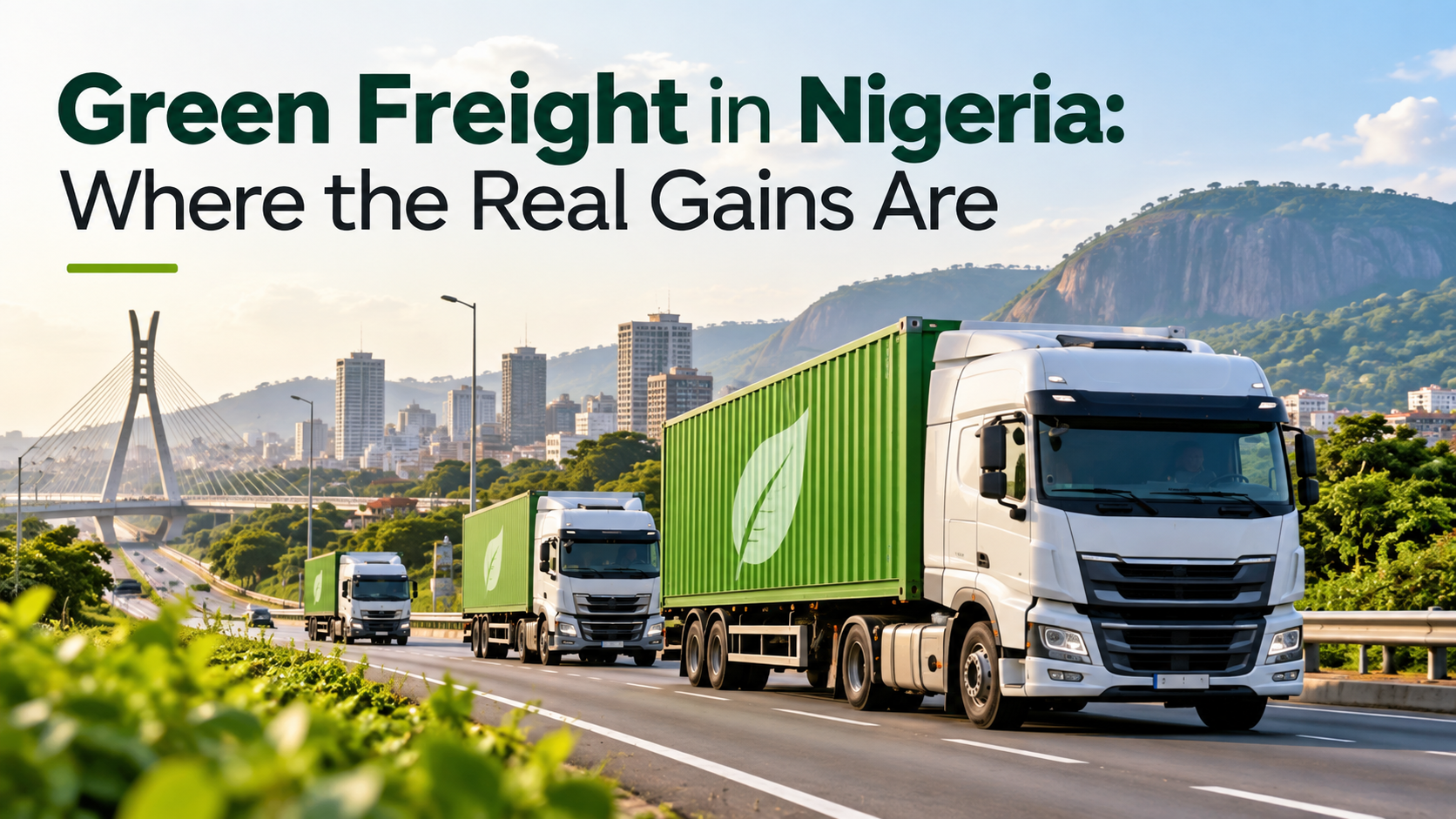
Almost everything moves by road
In Nigeria, if goods move, they almost certainly move on a truck. Road transport carries more than 90% of the country's internal freight and passengers. Rail, which handled over 60% of freight tonnage before independence, now carries less than 5% (Akujor et al., 2022). The same review found every part of the transport sector still runs on fossil fuel.
That makes freight a climate issue and a cost issue at the same time. Diesel prices, ageing trucks and long waits at Apapa all land on the shipper's invoice. So when people talk about green logistics here, the useful question is which changes cut emissions and cost together, because those are the ones operators will actually adopt.
Most writing on this topic comes from the US and Europe, where the conversation is about hydrogen trucks and big-budget electric fleets. A recent conference paper from Vytautas Magnus University makes the fair point that high upfront cost keeps smaller operators out of fleet electrification altogether (Ayyiniyil). In Nigeria, where so much haulage is done by small owner-operators, that barrier is most of the story. The gains worth chasing look different here.
Gas first, then electric
Nigeria's fuel shift in freight is being led by compressed natural gas, and it is moving faster than many expected. By late August 2026 more than 120,000 vehicles had been converted to CNG under the Presidential initiative, and the President ordered another 500 refuelling stations, bringing the planned national network to 1,000 (CGTN, Aug 2026). The stated target is one million CNG vehicles by 2027, and the initiative counts more than 4,000 Dangote trucks among the gas vehicles already on the road (PM News, Jan 2026).
Heavy haulage is where this matters most. Lagos State approved a ₦150 billion programme, with an initial ₦50 billion backed by a UBA soft loan, to replace old diesel trucks with 2,000 CNG units, and NARTO has backed it (Vanguard, Nov 2025). For a haulier the appeal is simple. Gas is cheaper than diesel per kilometre, and a newer truck breaks down less.
We should be clear about what CNG is, though. It is still a fossil fuel. It burns cleaner than diesel, particularly for soot and local air quality, but it is a bridge and not the destination. The practical risk for operators is buying into gas without a plan for what comes after, or without proof of the savings they claim. In March 2026 the programme's mandate was formally widened to include electric vehicles (Pi-CNG & EV), which tells you where policy is heading.
For long-haul trucks, electric is still some way off in Nigeria. Charging along the Lagos to Kano corridor does not exist at any useful scale, and grid supply is unreliable. For short urban work the picture is very different, as we'll see further down.
The cheapest tonne of carbon is the one you never burn
Before anyone spends on new vehicles, there is a bigger saving sitting in the trucks already on the road. A lot of them are driving around empty.
The pattern is familiar to anyone who has worked the Apapa corridor. Trucks carry imports north to Kano, Kaduna or Abuja, then come back with nothing because southbound cargo is seasonal and hard to find. A study of Lagos haulage firms found empty running was one of the strongest drivers of vehicle operating cost in the sample (Journal of Social Sciences Research). Research on East Africa's Northern Corridor found empty trucks produced 59% of the emissions on the return leg, more than the loaded ones (TTCA). We have no reason to think West Africa does better.
Filling that return leg costs almost nothing in hardware. It needs information. A shipper in Kano with goods for Lagos has to find out that a truck is heading that way on Thursday, and the transporter has to trust that the load is real and the payment will arrive. Digital freight matching exists to close that gap.
Routing is the other quiet win. The Vytautas Magnus paper cites evidence that route optimisation software typically cuts unnecessary mileage by 10 to 15%. On Nigerian roads, with checkpoints, flooding and gridlock that shift by the hour, the savings from better route and timing decisions could plausibly be larger, though we would want to see local data before quoting a figure.
For a transporter with three trucks, a full return load every week is worth far more than a grant towards a vehicle they cannot yet afford.
The last mile is where electric already works
In our cities the delivery vehicle is usually a motorcycle, a tricycle or a small van. These do short, predictable runs and return to base at night, which is exactly the duty cycle batteries handle well.
The market is moving. Battery-swap companies such as Spiro, MAX and Siltech are building networks in Nigeria, Bolt launched a small fleet of electric kekes in Lagos in 2025, and the startup Swap has converted just over 300 petrol tricycles with another 1,000 kits on order (TechCabal, Jul 2026). The Federal Government also announced 10,000 electric tricycles for distribution through the North East Development Commission from August 2026 (Nigeria Startup Act, Jun 2026).
The same TechCabal report is a useful reality check. Riders have run out of charge mid-route, there is no roadside fix like a jerrycan of petrol, and some swap stations are themselves powered by diesel generators. Electric last-mile delivery works best when routes are planned around where the batteries can be swapped, not the other way round.
Consolidation matters as much as the vehicle. Five half-empty bikes going to the same estate can easily burn more than one full van. Grouping orders by area and time slot is dull work, and it is often the single biggest saving a small delivery business can make.
If you can't measure it, you can't sell it
There is an international standard for counting freight emissions now. ISO 14083 was published in 2023, and the GLEC Framework from Smart Freight Centre is the main practical guide for applying it, used by shippers, carriers and logistics providers alike (Smart Freight Centre).
This is starting to reach Nigerian businesses through their customers. Large buyers reporting their supply-chain emissions increasingly ask transport suppliers for ISO 14083-aligned figures, and some tenders now name it as a requirement (GreenCalculus). The EU's Carbon Border Adjustment Mechanism entered its definitive phase on 1 January 2026, and embedded transport emissions form part of that calculation for goods such as fertiliser, aluminium and cement (EcoFreight). Nigerian exporters of those products will be asked for numbers they may not have.
The gap is local data. Default emission factors from Europe assume European trucks, European roads and European loading. A 20-year-old truck idling at a port gate for two days is not in those tables. Operators who start recording actual fuel use, distance and load per trip will be ahead of competitors who guess, and they will have evidence to back up the savings from CNG or better matching when a client or lender asks.
Where to start
For most Nigerian operators, green freight will not begin with a new truck. It begins with knowing your own numbers. How many kilometres did each vehicle run empty last month? What did fuel cost per delivered tonne? Which routes lose the most time?
Once those figures exist, the choices get clearer. A haulier can see whether a CNG conversion pays back on their routes. A distributor can see how much consolidation would save. A last-mile business can work out whether electric bikes fit its daily range.
Government has a part to play too. CNG stations and battery-swap points need to go where freight actually moves, and small transporters need finance they can reach. Common rules for how emissions are measured and checked would let Nigerian operators prove their performance to buyers at home and abroad.
At Sidante Maliz, this is the work we do. We help logistics businesses and public bodies measure what their fleets are doing, find the savings that are already there, and plan a transition that makes commercial sense. If you'd like to talk it through, write to us at hello@smgconsulting.ng.
Sources
- Akujor, C. E. et al. (2022). Decarbonisation of the Transport Sector in Nigeria. Environmental Health Insights.
- Ayyiniyil, S. The Future of Green Logistics: Sustainable Transportation Strategies. Proceedings of the 22nd Young Scientists Conference, Vytautas Magnus University Agriculture Academy.
- CGTN (28 Aug 2026). Nigeria targets lower transport fares as CNG use expands.
- P.M. News (18 Jan 2026). Nigeria targets 1 million CNG vehicles by 2027.
- Pi-CNG & EV. Impact and results.
- Vanguard (Nov 2025). CNG haulage initiative: Lagos, stakeholders strategise on deployment of 2,000 trucks.
- Factors influencing vehicle operating costs of haulage firms in Lagos. Journal of Social Sciences Research.
- TTCA. Multiple impact of empty freight transport trips along the Northern Corridor.
- TechCabal (30 Jul 2026). Nigeria's petrol three-wheelers are going electric.
- Nigeria Startup Act (15 Jun 2026). FG to launch 10,000 electric tricycles across Nigeria.
- Smart Freight Centre. The GLEC Framework.
- GreenCalculus. GLEC Framework reference.
- EcoFreight. Freight emissions glossary.