
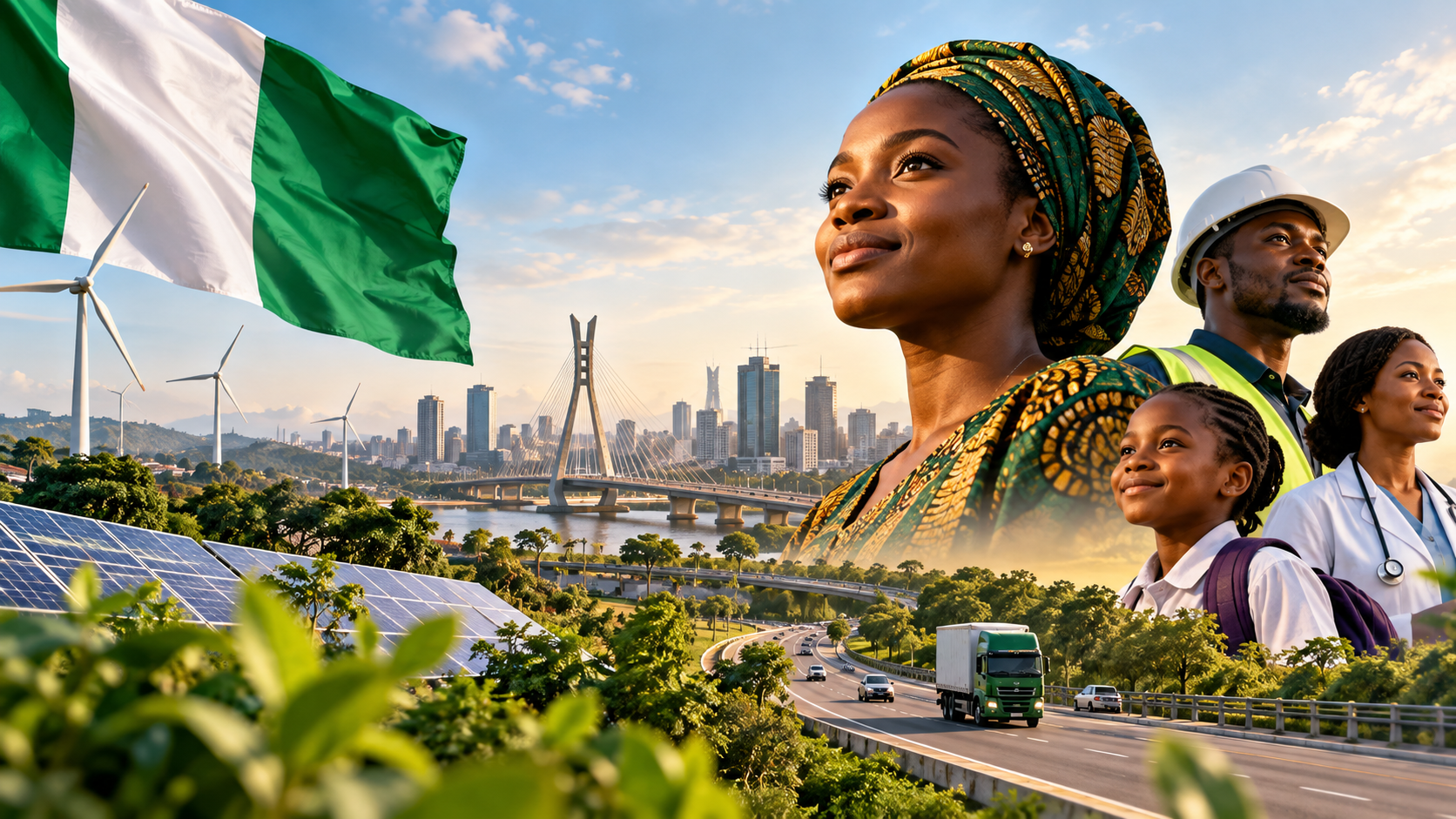
Nigeria is dealing with several crises at once: energy poverty, worsening climate impacts, inequality, and the need to move away from dependence on fossil fuels. These can't be solved one at a time. The country also has a lot to build on, including some of the strongest sunshine in the world, a young and enterprising population, serious national climate targets and a fast-growing renewable energy manufacturing sector.
This framework takes the approach Friends of the Earth UK set out for a green and fair recovery and rewrites it for Nigeria. It is built around five themes: health and wellbeing, green jobs, fixing the economy, global engagement, and empowering communities. Each section sets out the challenge, what Nigeria is already doing and what federal, state and local government, civil society and business should do next.
Climate action and economic growth can't be treated as competing goals. Nigeria's NDC 3.0, submitted in September 2025, estimates that delivery will cost $337 billion between 2026 and 2035, and projects up to 840,000 new direct jobs by 2060. Climate change already costs Nigeria an estimated $100 billion a year, a figure expected to reach $460 billion by 2050. Doing nothing is the most expensive option.
1. Health and wellbeing
The challenge. The World Bank ranks Nigeria among the ten countries most exposed to climate change. In the north, desertification threatens 75 million hectares, and the rainy season has shrunk from about 150 days to 120 over three decades, cutting food production by around 20%. In the south, floods already affect 25 million people. In Lagos, 375,000 people are exposed today, and that could reach 3.2 million by 2050.
Nearly three-quarters of households cook with firewood or kerosene, and the smoke kills an estimated 98,000 Nigerians a year, mostly women and children. Oil spills and gas flaring continue to damage the Niger Delta and the fishing communities that depend on it. Only about 55% of Nigerians have electricity, and the grid delivers around 4,000 MW against more than 12,000 MW of installed capacity.
What Nigeria is already doing. For the first time, NDC 3.0 brings health into Nigeria's climate commitments. It pledges clean energy for 44 federal tertiary hospitals and 2,000 climate-resilient primary healthcare centres by 2030. The DARES programme, the world's largest publicly funded energy access programme, aims to reach 17.5 million people through 2.5 million household connections and 1,350 mini-grids. The National Gas Expansion Programme aims to move 30 million homes from firewood and kerosene to LPG, although progress has been slow.
Recommendations
Universal clean cooking by 2035. Cooking smoke is Nigeria's hidden health emergency. Federal and state governments should set a binding target for universal clean cooking by 2035, combining LPG with solar-electric cooking for off-grid communities. Low-income households should get support through targeted social protection payments, and states should require clean cooking in all new public housing.
Off-grid solar for every community by 2030. DARES provides the base to scale from. States should map unserved communities and put health centres, schools and water treatment first. The mini-grid regulations allowing interconnected systems of up to 10 MW should be put fully into practice. The Rural Electrification Agency's results-based finance should also cover equipment for productive use, such as mills, cold stores and irrigation pumps, so that power drives income as well as lighting.
Climate-resilient health facilities. The 2,000 new health centres need capital funding, siting rules that keep them out of flood plains, and their own renewable power. States should prepare heatwave plans for cities, and climate health risks should be part of medical training.
Nature-based flood defences and the Great Green Wall. In the north, community-managed tree planting under the Great Green Wall should speed up across the 12 frontline states. In the south, mangroves, wetlands and floodplains should be protected and restored as natural flood defences. Lagos, Yenagoa and other flood-prone cities should build green space into their plans and replace hard surfaces with ground that absorbs water where they can.
2. Green jobs and livelihoods
The challenge. Nigeria has more than 220 million people, and over half of young people are unemployed or underemployed. Oil and gas bring in more than 90% of export earnings but make up only about 5% of GDP and very few formal jobs. The Energy Transition Plan says a managed transition could create 840,000 direct jobs by 2060, but only with deliberate policy. The signs are encouraging. In 2025, $425 million went into eight new renewable energy factories, and solar panels made in Lagos are now being exported to Ghana.
Recommendations
500,000 jobs in clean energy manufacturing by 2035. Solar manufacturing capacity has grown from 120 MW to 300 MW in two years, with 3.7 GW in the pipeline. Industrial policy should aim for a complete domestic supply chain, from silicon processing and cells to panels, inverters and batteries. Clean energy economic zones should go into states with high youth unemployment. Tariffs should protect young manufacturers while keeping prices affordable for buyers, so Nigeria can become West Africa's clean energy manufacturing hub.
A national green skills and apprenticeship programme. Technical and vocational training should put solar installation, mini-grid maintenance, batteries, energy-efficient building, sustainable farming and land restoration first. Each geopolitical zone should have at least one Centre of Excellence in Green Skills, co-funded by the federal government and development partners. A guaranteed apprenticeship for young people in green industries should be piloted.
Climate-smart farming for smallholders. Farming employs over 35% of the workforce and is highly exposed to climate change. Programmes should scale up drought-tolerant seed, better water management, agroforestry and solar irrigation. Extension services should be expanded and digitised, and affordable crop insurance widened through public-private partnerships. Part of the NDC target of 25 million trees a year should come from farmers regenerating trees on their own land, earning income from carbon credits.
A fair transition for oil and gas workers. Oil and gas will be part of the economy for years yet, but their long-term decline needs planning. A Just Transition Fund, paid for by a levy on oil and gas revenue, should fund retraining, local diversification and new infrastructure in oil-dependent areas. In the Niger Delta, cleaning up polluted sites should become a major source of jobs, and affected communities should come first for renewable energy investment and clean-up contracts.
3. An economy that works for people and the planet
The challenge. Under the Renewed Hope Agenda, Nigeria is aiming for a $1 trillion economy by 2030 while committing to cut emissions under NDC 3.0. The two can support each other. The Energy Transition Plan estimates that meeting climate targets would protect up to 30% of GDP from climate damage by 2050, but only if economic policy is designed for it. The cost-of-living crisis that followed subsidy removal and the naira's fall shows how much ordinary people still rely on fossil fuels. Any transition has to be affordable for the poorest.
Recommendations
End routine gas flaring by 2030 and put the money into clean energy. NDC 3.0 already commits to this. It needs real penalties and open monitoring. Money from flaring penalties and gas sales should be ring-fenced for renewables and energy access. The National Carbon Market Framework, approved in late 2025, should let flare-reduction projects earn carbon credits and bring in private investment.
Line up public finance with climate goals. The Nigerian Climate Investment Platform, set up with the Nigeria Sovereign Investment Authority, the National Council on Climate Change and the Green Climate Fund, should become the main channel for public climate finance. Every federal and state budget should tag climate spending against NDC 3.0. The Central Bank should issue green bond guidelines and offer better lending terms for climate-aligned investment. Remaining fossil fuel subsidies should be phased out, with the savings going to targeted support for the poorest households.
Measure wellbeing, not just GDP. The Renewed Hope Development Plan 2026–2030 should track energy access, air quality, forest cover, youth employment, food security and climate resilience alongside GDP. The National Bureau of Statistics should be funded to report these by state, and states that make progress should get priority for federal climate finance.
Tackle waste through a circular economy. Nigeria produces over 32 million tonnes of solid waste a year, and much of it is burned in the open. NDC 3.0 commits to cutting open burning by 40%. Federal law should make producers responsible for their packaging, set minimum recycled content and phase out single-use plastics. States should invest in sorting, recycling and composting. The informal waste-picking sector, which employs millions, should be supported and formalised rather than pushed aside.
4. Global engagement and accountability
The challenge. Nigeria contributes to climate change and suffers from it. It is a major oil and gas producer and one of sub-Saharan Africa's biggest methane emitters, yet emissions per person are a fraction of those in rich countries. Climate Action Tracker rates Nigeria's targets "Almost Sufficient", broadly fair for its stage of development, but delivery lags well behind ambition. International climate finance is nowhere near the $337 billion needed for 2026 to 2035. The Energy Transition Plan sought an initial $10 billion package ahead of COP27 and still had not secured enough by early 2026.
Recommendations
Press wealthy nations to deliver climate finance. As Africa's most populous country and one of its largest economies, Nigeria should lead a coalition pushing developed countries to meet and exceed their finance pledges. At COP31 and after, it should argue for a finance floor that reflects the real cost of transition. Government should publish an annual Climate Finance Accountability Report showing what was pledged, what arrived and what is still missing.
Get the carbon market working. The Carbon Market Framework approved in October 2025 needs open registries, clear benefit-sharing rules for local communities, and safeguards so that outside buyers can't take credits without real benefit to Nigerians. Carbon market revenue should be ring-fenced for adaptation in the most exposed communities.
Lead on clean energy in the region. Mozambique, Benin, Burkina Faso, Niger, Chad and Mauritania are already studying Nigeria's electrification model. That interest should be formalised through ECOWAS partnerships on off-grid energy. The recent ECOWAS agreement to put solar on 15 public institutions is a start. Nigeria should push for a regional off-grid market framework alongside the West African Power Pool.
Protect environmental standards in trade deals. As Nigeria deepens its role in the African Continental Free Trade Area, environmental and labour standards should be written into agreements. Government should refuse investment terms that let oil and gas companies challenge environmental rules through investor-state dispute settlement.
5. Empowering communities to lead
The challenge. Nigeria has 36 states, the FCT and 774 local government areas. Climate impacts differ hugely across them, from desertification in Borno to coastal flooding in Lagos and oil pollution in Bayelsa. Federal policy alone can't deliver a fair transition, yet states and local councils often lack the money, capacity or incentive to act. Civil society is active but under-funded, and the people most affected, especially women and young people, are often left out of decisions.
Recommendations
Give states and local government the powers and money to act. The National Council on Climate Change should set a framework for state climate plans backed by dedicated federal transfers. Every state should produce a Climate Action and Adaptation Plan in line with NDC 3.0, with technical help from the Council. Local governments should be funded to deliver local projects such as tree planting, flood defences, clean cooking and solar. The Rural Electrification Agency's mix of federal coordination and private delivery could be copied for adaptation.
Guarantee community participation. More than 50,000 Nigerians across all 36 states contributed to NDC 3.0. That should be the norm. Environmental assessments for major projects should be accessible to the people affected, carried out in local languages, and include binding consent. States should set up Citizens' Climate Assemblies that include women, young people and people with disabilities.
Put women and young people at the centre. Women carry most of the burden of energy poverty. They spend hours gathering firewood, cook over open fires and care for children made ill by the smoke. Climate programmes should treat women as decision-makers as well as beneficiaries. Young people make up over 60% of the population and should sit on every climate governance body. At least half of green skills places should go to women and people under 30, and local climate entrepreneurs should get microfinance on better terms.
Protect environmental defenders and civil society. Activists, journalists and community leaders face real risks, especially in the Niger Delta and other extraction areas. Federal law should protect the right to environmental protest and information, drawing on the Aarhus Convention and the Escazú Agreement. The National Climate Change Fund should give grassroots groups direct access to funding, not only through international intermediaries.
Summary of recommendations
| Recommendation | Key actions | Lead | Timeframe |
|---|---|---|---|
| 1. Health and wellbeing | |||
| Universal clean cooking | Subsidised LPG and solar cooking for off-grid areas | Federal and state | By 2035 |
| Off-grid solar for all | Deliver DARES; fund productive-use equipment | Federal (REA) | By 2030 |
| Climate-resilient health | 2,000 climate-proof health centres; hospital solar | Federal and state | By 2030 |
| Nature-based flood defence | Great Green Wall; mangrove restoration; urban green space | Federal and state | Ongoing |
| 2. Green jobs and livelihoods | |||
| 500,000 manufacturing jobs | Solar supply chain; clean energy economic zones | Federal | By 2035 |
| Green skills programme | Six zonal Centres of Excellence; TVET reform | Federal and state | By 2028 |
| Climate-smart farming | Drought-tolerant crops; solar irrigation; carbon credits | Federal and state | Ongoing |
| Just Transition Fund | Oil revenue levy; Niger Delta clean-up; retraining | Federal | By 2027 |
| 3. Fixing the economy | |||
| End gas flaring | Enforce penalties; carbon credits for flare reduction | Federal | By 2030 |
| Align public finance | Climate-tag budgets; green bonds; end fossil subsidies | Federal and CBN | By 2028 |
| Wellbeing dashboard | Track energy access, air quality, forests, youth jobs | Federal (NBS) | By 2027 |
| Circular economy | Producer responsibility; plastics phase-out; support waste-pickers | Federal and state | Phased |
| 4. Global engagement | |||
| Climate finance | Lead an African coalition; annual accountability report | Federal | Ongoing |
| Carbon market | Launch the framework; community benefit-sharing | Federal (NCCC) | By 2027 |
| Regional leadership | ECOWAS off-grid market; solar export hub | Federal (REA) | Ongoing |
| Standards in trade | Standards in AfCFTA deals; no ISDS for extractives | Federal | Ongoing |
| 5. Empowering communities | |||
| Devolve climate powers | State climate plans; local adaptation budgets | Federal and state | By 2028 |
| Community participation | Accessible assessments; Citizens' Climate Assemblies | State and LGA | Ongoing |
| Women and youth | 50% of programme places; microfinance; seats on bodies | All levels | Ongoing |
| Environmental defenders | Legal protection; direct funding for grassroots groups | Federal | By 2027 |
About this framework
This piece adapts the structure of Friends of the Earth's Policies for Green and Fair Recovery Plans Across the UK (July 2020), written by Mike Childs, Head of Policy at Friends of the Earth England, Wales and Northern Ireland, for the UK after COVID.
The Nigerian version is rewritten from scratch. It draws on NDC 3.0 (September 2025), the Energy Transition Plan, the Renewed Hope Development Plan 2026–2030, the National Carbon Market Framework and the DARES programme, along with Climate Action Tracker, UNDP Climate Promise, the Africa Policy Research Institute and Nigerian government agencies. The recommendations are our own.
SMG Consulting works with public bodies and businesses on low-carbon transport, logistics and energy in Nigeria. To discuss any of these recommendations, write to hello@smgconsulting.ng.