
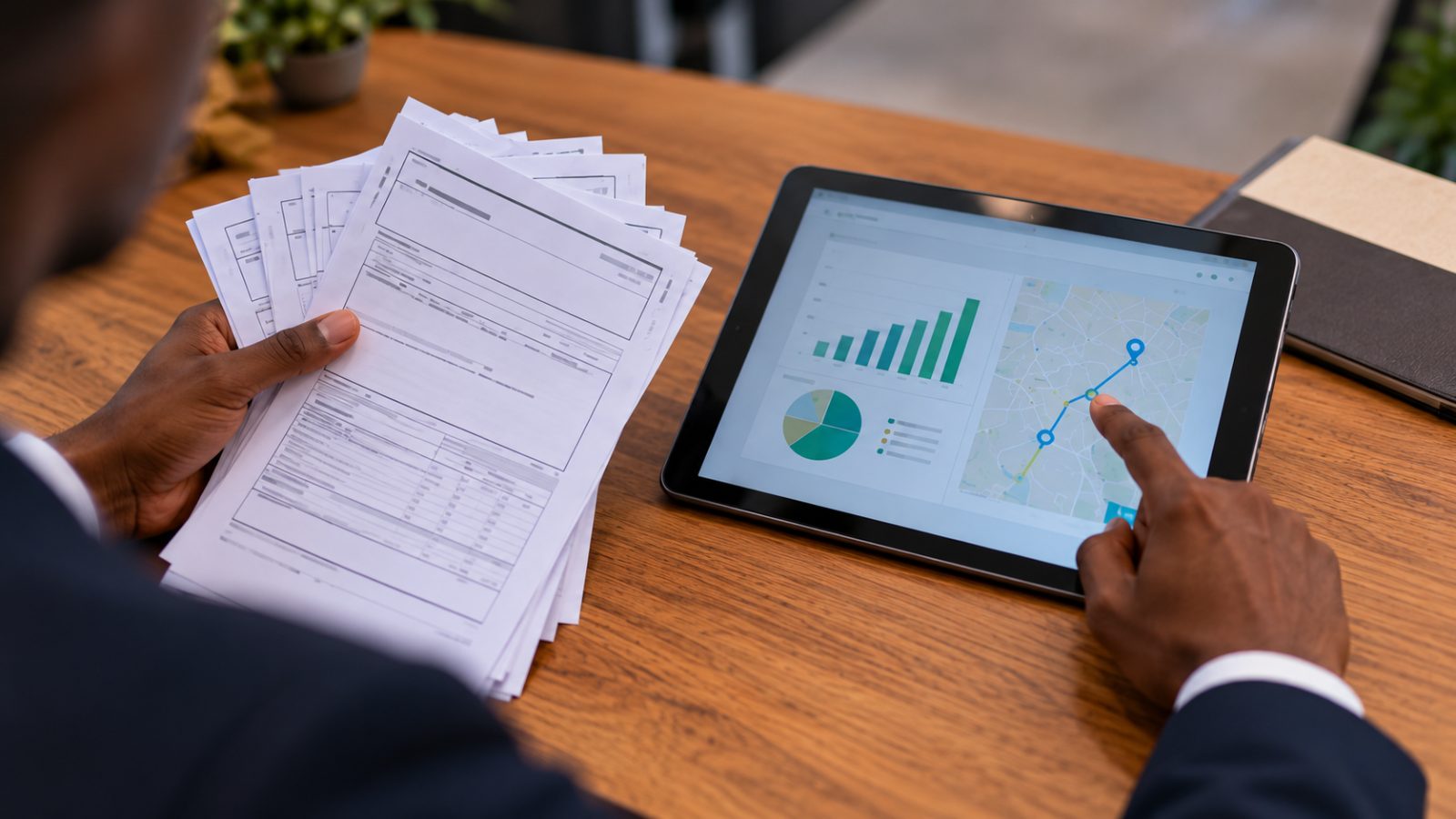
There is a common assumption that measuring transport emissions needs expensive software, GPS trackers and a data team. Plenty of Nigerian businesses have none of these, and many never will. They run on paper waybills, phone calls and notebooks, and they move a great deal of the country's goods. The good news is that the humble waybill can be the starting point for credible carbon data.
What a waybill already tells you
A typical waybill records where goods were collected, where they were delivered, what was carried, how much of it, and often the vehicle and driver. Put those details together and you have most of what an emissions calculation needs. The origin and destination give you a distance. The vehicle tells you the likely fuel type and consumption. The quantity of goods lets you share the emissions fairly between customers.
What is usually missing is consistency. One driver writes the plate number, another writes the driver's first name, a third leaves it blank. One branch notes the weight in kilograms, another in bags. Fixing this is the first and most important step.
The details worth capturing every time
Make sure each waybill records the date, the place of collection and the place of delivery as precisely as possible, the vehicle registration, the type of vehicle, the fuel it uses, and the weight or number of items carried. If the business pays for fuel, link fuel purchases to the vehicle registration rather than recording them as a lump sum.
None of these is new information. It simply needs writing down the same way every time.
From paper to numbers
Once a month, someone types the waybill details into a simple spreadsheet, one row per trip. Distance can be looked up on a map for each route and reused, since most businesses travel the same routes again and again. Average fuel use per kilometre for each vehicle type can be worked out from fuel records or taken from published defaults. Multiply distance by fuel use and by the right emission factor and you have the emissions for each trip, which can then be shared across the customers whose goods were on board.
The result will not be as precise as figures from vehicle trackers, and you should say so when you report it. Recognised methods such as ISO 14083 accept modelled data of this kind as long as the method is explained.
Why this matters beyond your own business
Much of Nigeria's freight is moved by small operators, motor park transporters and informal hauliers who will never install telematics. If national climate reporting and corporate supply chain figures only count businesses with software, they will miss a large part of the picture. Building good habits around paper records is one way to bring that part of the sector into the data, and to make sure Nigerian transport is measured on Nigerian evidence rather than borrowed averages.
SMG works with businesses that hold their transport records on paper and helps turn them into usable data. If that sounds like your business, we would be glad to hear from you.